
Business Rules Inference for Decision Guidance Engine
ASP – Digital Twin – Smart Tourism – Explainable AI
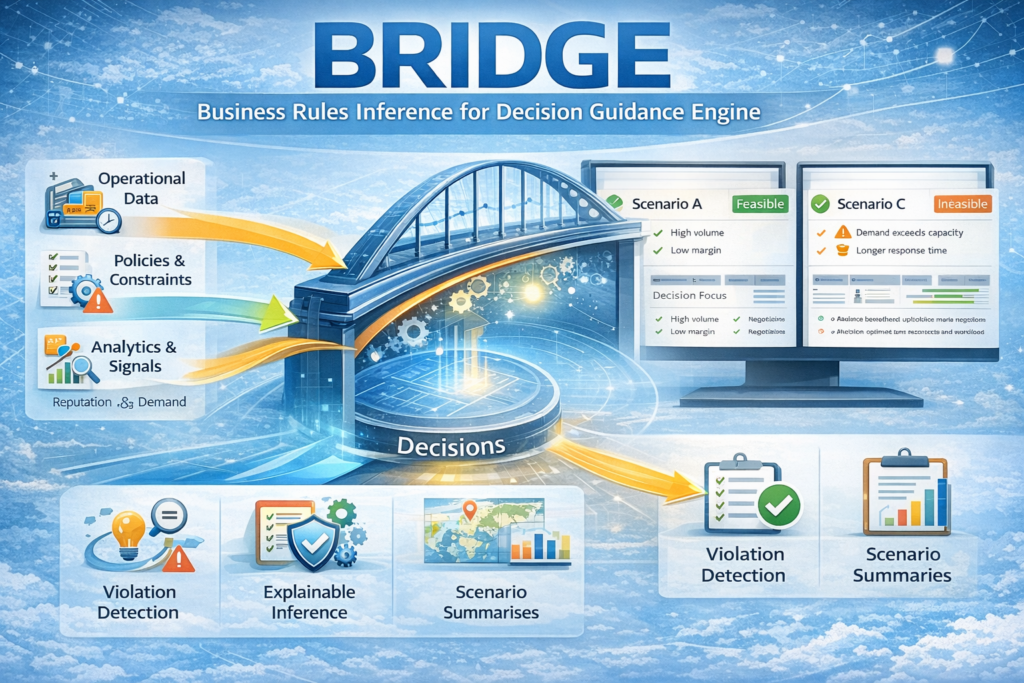
BRIDGE (Business Rules Inference for Decision Guidance Engine) is a rule-based decision support engine built on Answer Set Programming (ASP) for generating, validating, and comparing operational scenarios under explicit constraints. The system encodes a digital model of an organization as a set of declarative rules capturing offerings/policies, resource and capacity constraints, operational limits, and decision objectives. Given a scenario definition and a set of configurable parameters, WISE performs constraint-aware reasoning to determine feasibility, identify rule/constraint violations, and compute admissible alternatives that satisfy the model.
BRIDGE is designed for what-if analysis: users can vary policies, capacities, priorities, and external conditions to explore trade-offs across competing objectives (e.g., volume vs. margin, service quality vs. workload, experience design vs. operational sustainability). The inference layer supports explainability by construction: outcomes can be traced back to the rules and constraints that triggered accept/reject decisions or drove the selection of one admissible scenario over others. This makes BRIDGE suitable for settings where decisions must be justifiable and auditable, and where changes in policies or priorities should produce predictable, inspectable changes in recommendations.
From a systems perspective, BRIDGE can ingest internal operational data (availability, workloads, timing/cost parameters, policy configurations) and can be coupled with upstream analytics modules. In particular, it can incorporate reputation-derived signals (e.g., recurring issues and perceived quality drivers from RUMOR) and demand/segmentation indicators (e.g., segment prevalence and spend patterns from TRACES, including composite territorial indices such as STI) as inputs or constraints shaping the admissible decision space. BRIDGE exposes outputs as structured scenario summaries and decision reports, and can be integrated with lightweight user interfaces for non-expert parameter tuning and iterative what-if exploration.
Contacts:
Prof. Luca Pulina