
TRavel Analytics, Clustering & Economic Segmentation
AI Analytics – NLP – Tourism – Explainable AI
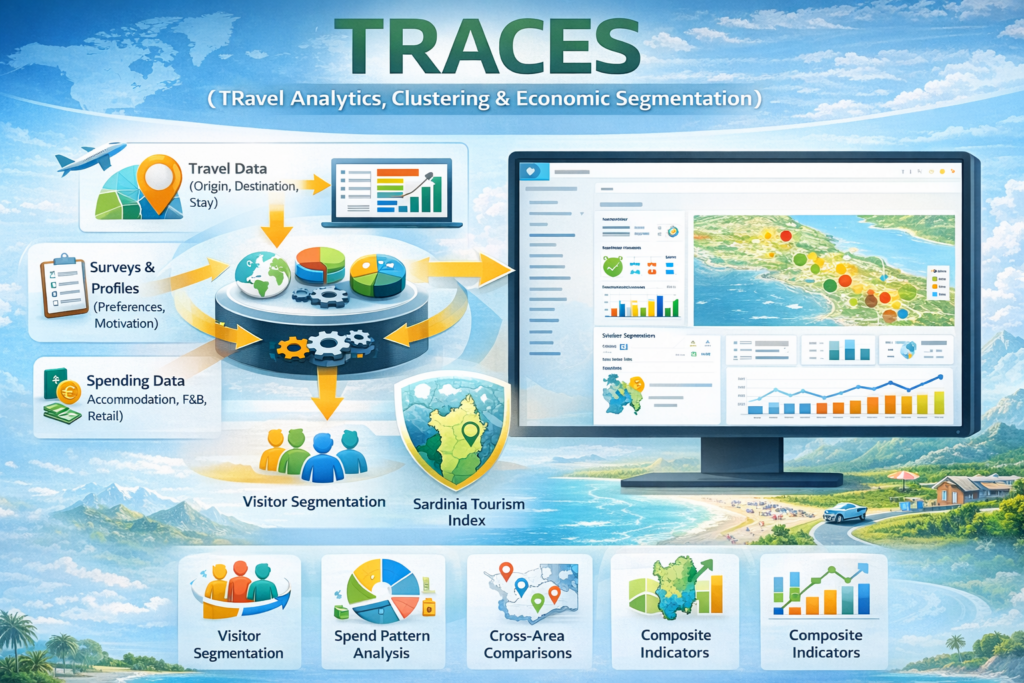
TRACES (TRavel Analytics, Clustering & Economic Segmentation) is a modular AI-driven analytics engine for demand profiling, visitor segmentation, and spend-pattern characterization across territories and time. The tool ingests structured observational/survey data describing travel behavior (origin, destination/area, period, stay/visit duration), motivations and preferences (e.g., seaside, nature, culture, food & wine), and expenditure breakdowns by category (accommodation, F&B, mobility, activities, retail). It produces interpretable segments and longitudinal indicators that enable cross-area and cross-period comparisons.
On the modeling side, TRACES supports a configurable segmentation workflow (feature engineering, clustering/mixture models or other unsupervised pipelines, segment labeling, stability checks) and derives segment-level summaries such as prevalence, seasonality, duration profiles, and spend mix distributions. A dedicated NLP layer processes open-ended responses and free-text comments, performing thematic structuring (topic/keyword grouping), summarization, and linkage of qualitative drivers to quantitative segment descriptors and spend patterns.
A key component of TRACES is its integration of contextual territorial signals into composite indicators, including the Sardinia Tourism Index (STI). STI is designed as a synthetic “touristicity” measure for a given area, combining perception-based evidence extracted from online feedback (via the RUMOR reputation/sentiment pipeline) with additional contextual features. This coupling enables joint analyses where segmentation outputs can be interpreted alongside area-level positioning and dynamics, supporting data-informed decisions on product/service design, communication strategies, and seasonal planning. TRACES persists outputs in structured, versioned data models to ensure reproducibility and supports export interfaces for downstream dashboards and decision-support modules.
Contacts:
Prof. Veronica Camerada